Aurora Australis in Australia Tonight: Southern Lights Forecast & Viewing Guide
Australia sees the aurora australis only in strong storms, with the Kp needed ranging from 4.6 in Tasmania to 8.8 in the north. Southern Tasmania and Victoria have the best odds.
Best chance in Australia tonight
Low Cockle Creek, Tasmania: low, peak Kp 3.7, clouds 32%, best 10 PM – 12 AM AEDT.
1 of 10 locations has a chance tonight.
Tonight's aurora map of Australia
Live aurora map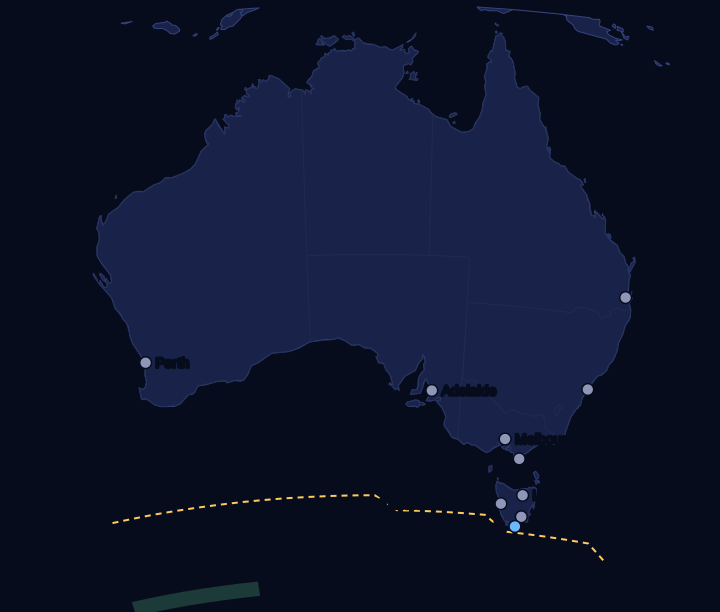
Free app for iPhone and Android
Know when the sky is worth your time
The forecast on this page, watching your location all night and telling you when to step outside.
The oval and the clouds over your spot, refreshed through the night.
A push alert before the aurora reaches your sky.
The one hour tonight worth setting an alarm for.
Aurora destinations in Australia
Hobart aurora forecast
Launceston aurora forecast
Melbourne aurora forecast
Adelaide aurora forecast
Sydney aurora forecast
Perth aurora forecast
Brisbane aurora forecast
Cockle Creek, Tasmania
Strahan, Tasmania
Wilsons Promontory, Victoria
Live aurora status: Hobart live forecast · Launceston live forecast · Melbourne live forecast
What time to look tonight in Australia
AWST
10 PM – 1 AM AWST
Perth: unlikely
ACST
10 PM – 12 AM ACDT
Adelaide: unlikely
AEST
10 PM – 12 AM AEST
Brisbane: unlikely
Sydney/Hobart
10 PM – 12 AM AEDT
Cockle Creek, Tasmania: low
Best window of the best-placed location in each zone. Look south; the darker your horizon, the earlier you see it.
Aurora viewing guide for Australia
The best season for the aurora australis in Australia is the dark half of the year, roughly March to September, with the longest nights in June and July. The equinox months of March and September are often more active, so those are the weeks to watch. In the tropical north and the interior, the clearer winter air helps, but the aurora itself is far too low to see.
The southern coast is where it happens. Tasmania is closest to the south pole and gets the most chances, with Hobart and Launceston the main cities. Victoria follows, with the south-facing coast near Melbourne. South Australia and southern New South Wales have fewer chances, and Perth, Brisbane and Sydney need very strong storms. Look south, find a dark horizon over water or low land, and be ready for a faint pink or red glow before anything else.
Winter weather is the big constraint. Cold fronts from the Southern Ocean bring cloud, rain and wind, especially to Tasmania and Victoria, so the clear spells between fronts are your windows. A high Kp number means little under overcast skies.
Aurora nights by month
Average dark nights per month when Kp reached the local threshold, across 10 places, since 2015.
Most active months: Mar, Aug, Sep, Oct.
Tasmania and Victoria: where Australia sees the aurora most
Tasmania sits at the southern edge of the continent and sees the aurora more often than anywhere else in Australia. Hobart has dark water and open southern horizons just beyond the suburbs, and Launceston lets you drive out to dark coast and farmland in the north. Remote spots such as Cockle Creek and the west coast have almost no light pollution at all.
Victoria is the best bet on the mainland. Melbourne puts you within a drive of south-facing headlands on the Mornington and Bellarine peninsulas, and Wilsons Promontory and the south coast stay dark all the way to Bass Strait.
Plan your Australia aurora trip
Australia Aurora FAQ
When is the best time to see the aurora australis in Australia?
Where in Australia can I see the southern lights?
How many nights should I plan for the southern lights in Australia?
Can I see the aurora australis from major Australian cities?
What Kp do I need to see the aurora australis in Australia?
Can I see the aurora australis in Australia tonight?
Learn more about the northern lights
How to See the Northern Lights: A Beginner's Guide
Three conditions decide whether you see the northern lights: activity at your latitude, a clear sky and darkness. Here is how to check each one.
Aurora Colors and What They Mean
Green, red, blue, purple and pink aurora explained: which gas makes each color, how high it glows, and why your camera shows more than your eyes.
Northern Lights in Canada: Best Places
The best places to see the northern lights in Canada: Yellowknife, Whitehorse, Churchill, Jasper and the prairies, plus what Ontario and Quebec get.
Northern Lights in Scotland
Where to see the northern lights in Scotland: north coast, islands, Cairngorms and dark sky parks, when the sky is dark enough, and how to beat cloud.
Northern Lights in Norway
Where to see the northern lights in Norway, which months work, why the coast and inland need different plans, and what Oslo gets in a storm.
Aurora Australis Forecast Guide
How to read a forecast for the southern lights: Kp, Bz, the southern oval, darkness, moon and cloud, plus where to look in Tasmania and southern Australia.
Kp index today
Live Kp, the 3-day and 27-day forecast, and what Kp each city needs.
Geomagnetic storm today
G-scale now, the storm outlook and how far south the aurora reaches.