Northern Lights in the US Tonight: Aurora Forecast & Viewing Guide
Alaska sees the aurora on most clear, dark nights, while the Lower 48 needs a real storm. Thresholds across the country run from Kp 1.6 in the far north to Kp 7.9 in the south.
Best chance in the US tonight
Moderate Juneau: moderate, peak Kp 3.7, clouds 84%, best 12 AM – 2 AM AKST.
3 of 18 locations have a chance tonight.
Tonight's aurora map of the US
Live aurora map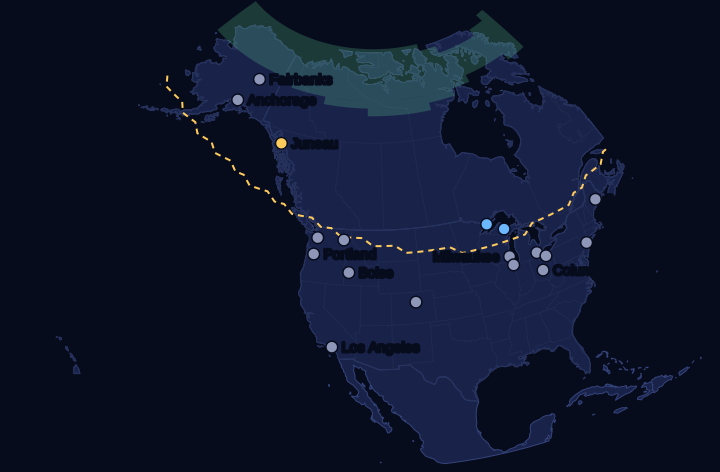
Free app for iPhone and Android
Know when the sky is worth your time
The forecast on this page, watching your location all night and telling you when to step outside.
The oval and the clouds over your spot, refreshed through the night.
A push alert before the aurora reaches your sky.
The one hour tonight worth setting an alarm for.
Aurora destinations in the US
Juneau aurora forecast
Fairbanks aurora forecast
Anchorage aurora forecast
Spokane aurora forecast
Seattle aurora forecast
Milwaukee aurora forecast
Bangor aurora forecast
Detroit aurora forecast
Chicago aurora forecast
Portland aurora forecast
Cleveland aurora forecast
Boise aurora forecast
Columbus aurora forecast
New York aurora forecast
Denver aurora forecast
Los Angeles aurora forecast
Grand Marais, Minnesota
Marquette, Michigan
Live aurora status: Juneau live forecast · Fairbanks live forecast · Anchorage live forecast
What time to look tonight in the US
AKT
12 AM – 2 AM AKST
Juneau: moderate
PT
2 AM – 5 AM PST
Spokane: unlikely
MT
1 AM – 5 AM MST
Boise: unlikely
CT
10 PM – 12 AM CST
Grand Marais, Minnesota: low
ET
11 PM – 1 AM EST
Marquette, Michigan: low
Best window of the best-placed location in each zone. Look north; the darker your horizon, the earlier you see it.
States with an aurora forecast
Michigan
MI5 locations · Kp 4.1–5.3
Pennsylvania
PA5 locations · Kp 5.4–6.0
Montana
MT5 locations · Kp 4.2–4.9
California
CA5 locations · Kp 6.5–8.2
Colorado
CO5 locations · Kp 5.9–6.3
Virginia
VA5 locations · Kp 6.1–6.7
Vermont
VT5 locations · Kp 5.1–5.5
Florida
FL5 locations · Kp 7.9–9.0
Wisconsin
WI5 locations · Kp 4.3–5.1
Iowa
IA5 locations · Kp 5.1–5.5
Ohio
OH4 locations · Kp 5.5–6.0
Kansas
KS4 locations · Kp 6.0–6.3
Oregon
OR5 locations · Kp 5.5–6.1
Arizona
AZ4 locations · Kp 6.9–8.0
Washington
WA4 locations · Kp 4.8–5.2
Alaska
AK5 locations · Kp 1.0–3.0
Aurora viewing guide for the US
The best months are September through April, when nights are long enough to be properly dark. Around the equinoxes, in March and September, geomagnetic activity tends to run a little higher, which helps. In Alaska, the summer sun keeps the sky bright from late spring to midsummer, so the season there starts in late August. In the Lower 48, the same calendar applies, but storms matter more than the month, and they come at the pace of the solar cycle.
Where you go sets your odds. Interior Alaska is the surest place in the country, and the northern Great Lakes, northern Maine, Montana and the Dakotas are the best of the Lower 48. Winter cloud decides many nights: the Great Lakes and Pacific Northwest are often overcast, while the Mountain West and Alaska interior have more clear skies. A moonless night helps everywhere. Away from cities, any dark site with an open view north works. Ordinary lighting washes out the faint glow, so plan to leave town.
Aurora nights by month
Average dark nights per month when Kp reached the local threshold, across 18 places, since 2015.
Most active months: Mar, Apr, Sep, Oct.
Alaska vs. the Lower 48
In Alaska, the aurora is routine. Fairbanks and the interior sit under the auroral oval, so a quiet night with a clear sky can bring a display, and a weak storm can fill the whole sky. Anchorage and Juneau are farther from the oval, so they need a moderate storm, and cloud is the usual limit. See Alaska for the whole state, or Fairbanks for the sure bet.
In the Lower 48, the aurora is a storm event. The northern tier, including Michigan’s Upper Peninsula, northern Minnesota and Maine, needs a strong storm, and the glow shows as a pale arc low in the north. Farther south, only the severe storms that come a few times in a solar cycle bring it, and phone cameras often detect it before your eyes. Treat these as chances, not plans.
The darkest northern horizons in the Lower 48 are in northern Maine, the Upper Peninsula and Lake Superior shore, northern Minnesota, Montana and the Idaho and Oregon high desert, where there is little light between you and Canada. The Great Lakes also help: a north-facing shore looks over open water. Michigan is the best starting point east of the Rockies.
Plan your US aurora trip
US Aurora FAQ
When is the best time to see the northern lights in the United States?
Where in the United States can I see the northern lights?
How many nights should I plan for the northern lights in the United States?
Can I see the northern lights from major cities in the United States?
What Kp do I need to see the northern lights in the US?
Can I see the northern lights in the US tonight?
Learn more about the northern lights
How to See the Northern Lights: A Beginner's Guide
Three conditions decide whether you see the northern lights: activity at your latitude, a clear sky and darkness. Here is how to check each one.
Aurora Colors and What They Mean
Green, red, blue, purple and pink aurora explained: which gas makes each color, how high it glows, and why your camera shows more than your eyes.
Northern Lights in Canada: Best Places
The best places to see the northern lights in Canada: Yellowknife, Whitehorse, Churchill, Jasper and the prairies, plus what Ontario and Quebec get.
Northern Lights in Scotland
Where to see the northern lights in Scotland: north coast, islands, Cairngorms and dark sky parks, when the sky is dark enough, and how to beat cloud.
Northern Lights in Norway
Where to see the northern lights in Norway, which months work, why the coast and inland need different plans, and what Oslo gets in a storm.
Aurora Australis Forecast Guide
How to read a forecast for the southern lights: Kp, Bz, the southern oval, darkness, moon and cloud, plus where to look in Tasmania and southern Australia.
Kp index today
Live Kp, the 3-day and 27-day forecast, and what Kp each city needs.
Geomagnetic storm today
G-scale now, the storm outlook and how far south the aurora reaches.