Northern Lights in Canada Tonight: Aurora Forecast & Viewing Guide
Canada has some of the best aurora odds in the world: its northern cities sit under the auroral oval, and even the southern ones see a storm now and then. Thresholds across our cities run from Kp 1.0 to 5.1.
Best chance in Canada tonight
Moderate Whitehorse: moderate, peak Kp 3.7, clouds 77%, best 1 AM – 3 AM MST.
6 of 14 locations have a chance tonight.
Tonight's aurora map of Canada
Live aurora map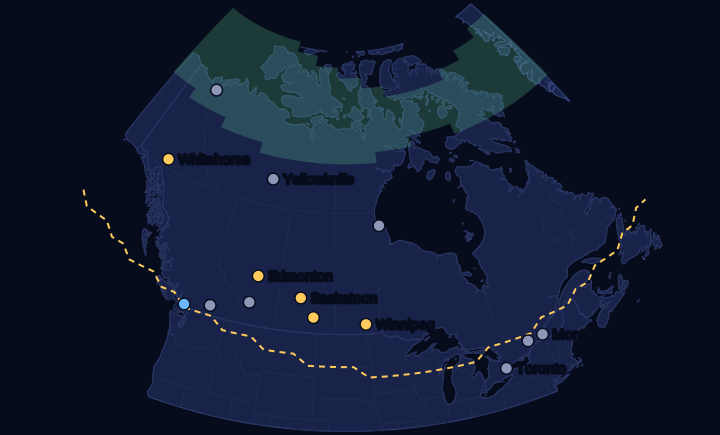
Free app for iPhone and Android
Know when the sky is worth your time
The forecast on this page, watching your location all night and telling you when to step outside.
The oval and the clouds over your spot, refreshed through the night.
A push alert before the aurora reaches your sky.
The one hour tonight worth setting an alarm for.
Aurora destinations in Canada
Whitehorse aurora forecast
Winnipeg aurora forecast
Edmonton aurora forecast
Saskatoon aurora forecast
Regina aurora forecast
Vancouver aurora forecast
Yellowknife aurora forecast
Calgary aurora forecast
Kelowna aurora forecast
Ottawa aurora forecast
Montreal aurora forecast
Toronto aurora forecast
Churchill
Inuvik
Live aurora status: Whitehorse live forecast · Winnipeg live forecast · Edmonton live forecast
What time to look tonight in Canada
PT
1 AM – 3 AM MST
Whitehorse: moderate
MT
2 AM – 4 AM MDT
Edmonton: moderate
CT
10 PM – 12 AM CDT
Winnipeg: moderate
ET
10 PM – 12 AM CDT
Winnipeg: moderate
Best window of the best-placed location in each zone. Look north; the darker your horizon, the earlier you see it.
Provinces with an aurora forecast
Aurora viewing guide for Canada
The best months for aurora in Canada are February, March, September and October, when nights are long and the air is cold and dry. The northern territories see the lights on most clear nights; the Prairie provinces are a good second choice, and the big cities in the south and on the coast need a strong storm. In the far north the summer nights are too bright, so travel there from late summer to early spring.
Geography decides the odds. Yellowknife, Whitehorse and Churchill sit under the oval. Edmonton, Winnipeg, Saskatoon and Regina are in the Prairie belt, with flat land and open northern horizons. Toronto, Ottawa, Montreal and Vancouver are the hard cases: light, cloud and, on the coast and in the Great Lakes region, frequent winter overcast. Cloud is the real limit everywhere, so a clear forecast matters more than the Kp number. Canada also has a long list of RASC Dark-Sky Preserves, from Muskoka and the Bruce Peninsula to Cypress Hills and Jasper.
Aurora nights by month
Average dark nights per month when Kp reached the local threshold, across 14 places, since 2015.
Most active months: Feb, Mar, Sep, Oct.
Where to fly for a northern lights trip in Canada
Yellowknife is the classic choice. The city is in the Northwest Territories, close to the auroral oval, and guided aurora trips run from town along the Ingraham Trail. The season runs from late summer to early spring. Clear nights are common in the dry months, and the city is small enough that you can see the lights near your hotel.
Whitehorse in the Yukon is the other major choice. Travel Yukon puts the season from mid August to mid April, and the lakes outside town, such as Fish Lake, give wide-open views. It is easy to reach by air and has a good mix of tours and independent options.
Churchill, Manitoba, on Hudson Bay, is the most remote of the three. It has no road connection, so you arrive by train or air, and the town is small. The reward is a sky well inside the oval and almost no light around you. Plan around the weather, which is harsh in midwinter, and book early because capacity is limited.
Plan your Canada aurora trip
Canada Aurora FAQ
When is the best time to see the northern lights in Canada?
Where in Canada can I see the northern lights?
How many nights should I plan for the northern lights in Canada?
Can I see the northern lights from major cities in Canada?
What Kp do I need to see the northern lights in Canada?
Can I see the northern lights in Canada tonight?
Learn more about the northern lights
How to See the Northern Lights: A Beginner's Guide
Three conditions decide whether you see the northern lights: activity at your latitude, a clear sky and darkness. Here is how to check each one.
Aurora Colors and What They Mean
Green, red, blue, purple and pink aurora explained: which gas makes each color, how high it glows, and why your camera shows more than your eyes.
Northern Lights in Canada: Best Places
The best places to see the northern lights in Canada: Yellowknife, Whitehorse, Churchill, Jasper and the prairies, plus what Ontario and Quebec get.
Northern Lights in Scotland
Where to see the northern lights in Scotland: north coast, islands, Cairngorms and dark sky parks, when the sky is dark enough, and how to beat cloud.
Northern Lights in Norway
Where to see the northern lights in Norway, which months work, why the coast and inland need different plans, and what Oslo gets in a storm.
Aurora Australis Forecast Guide
How to read a forecast for the southern lights: Kp, Bz, the southern oval, darkness, moon and cloud, plus where to look in Tasmania and southern Australia.
Kp index today
Live Kp, the 3-day and 27-day forecast, and what Kp each city needs.
Geomagnetic storm today
G-scale now, the storm outlook and how far south the aurora reaches.